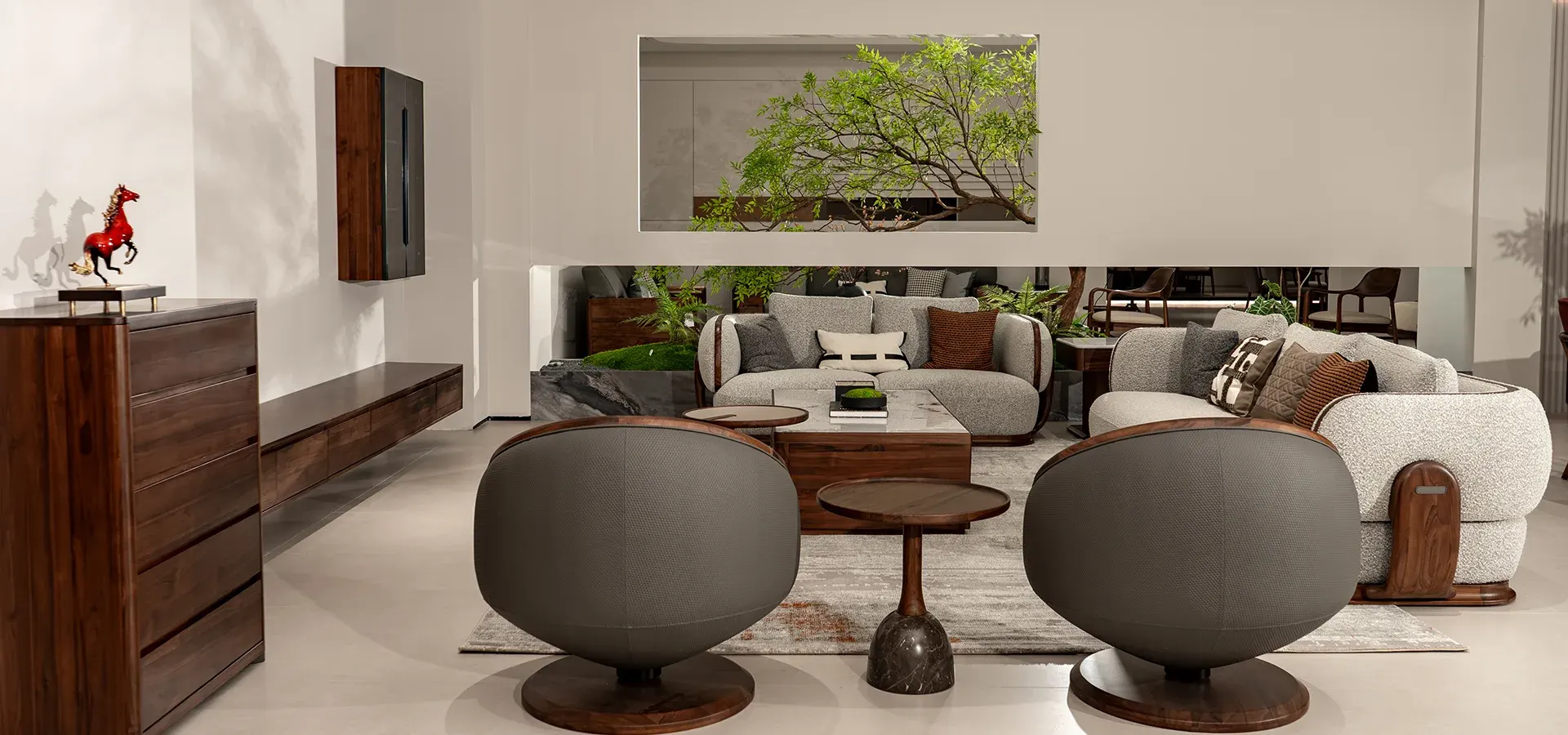
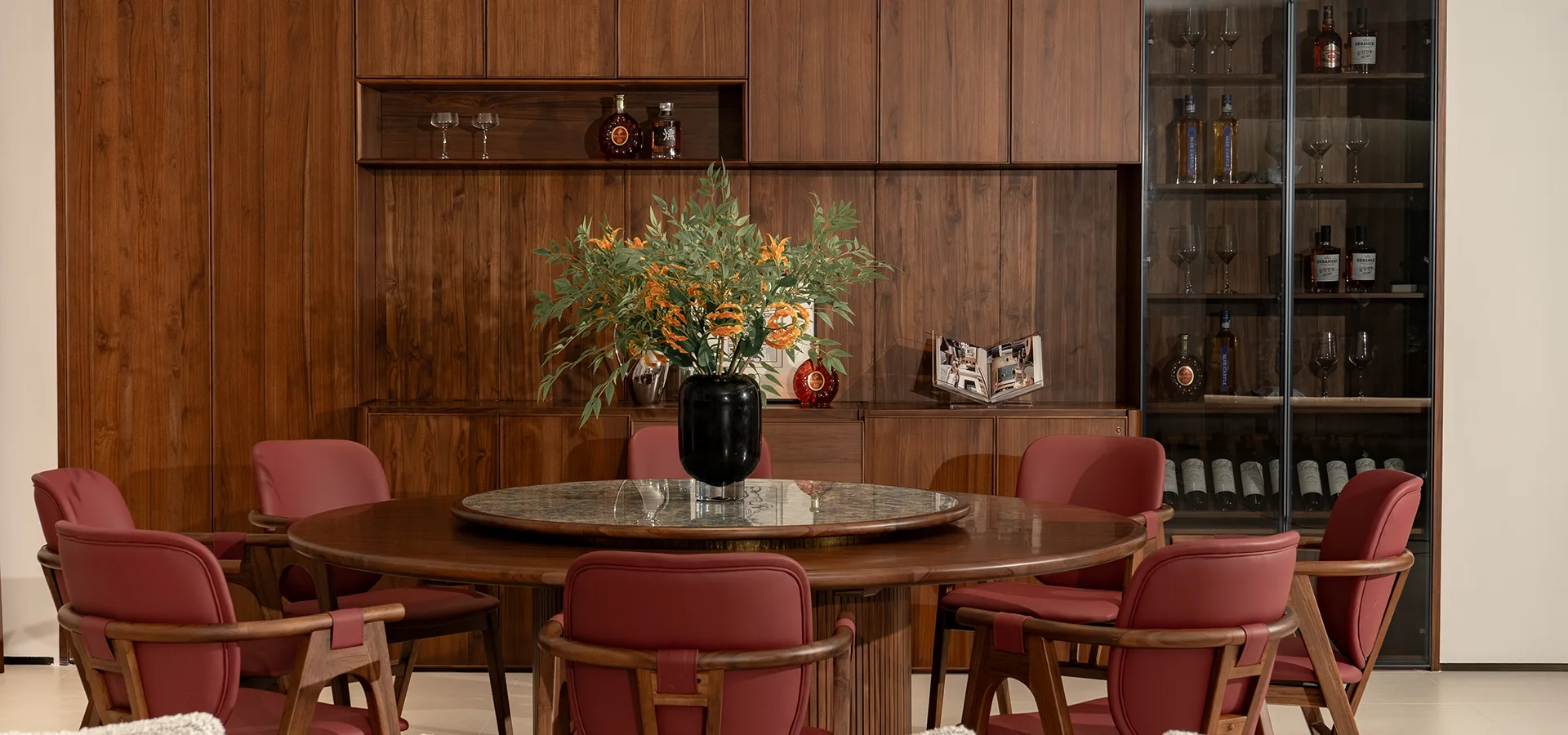
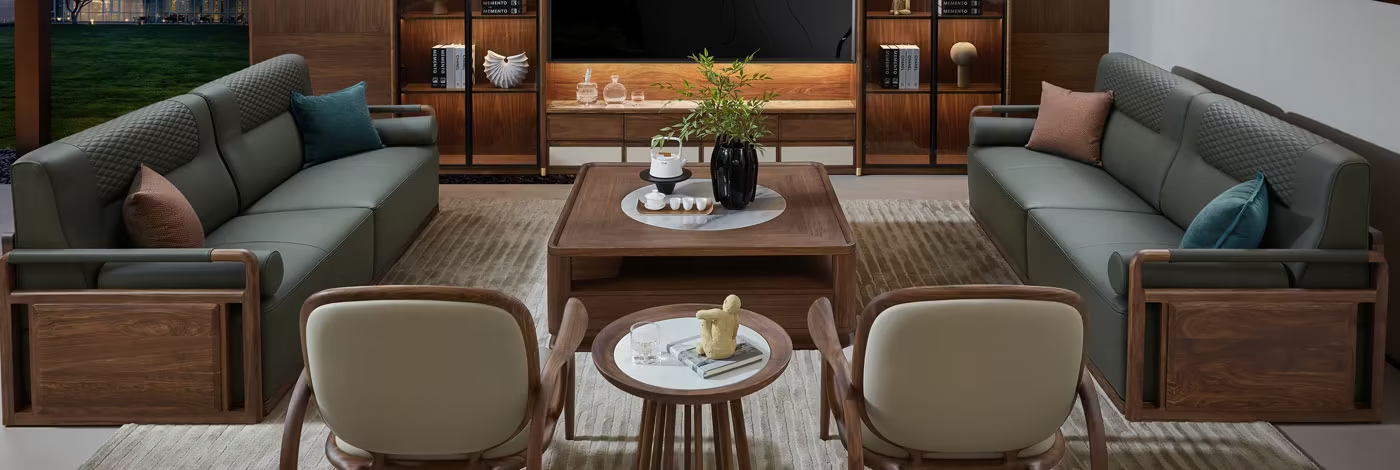
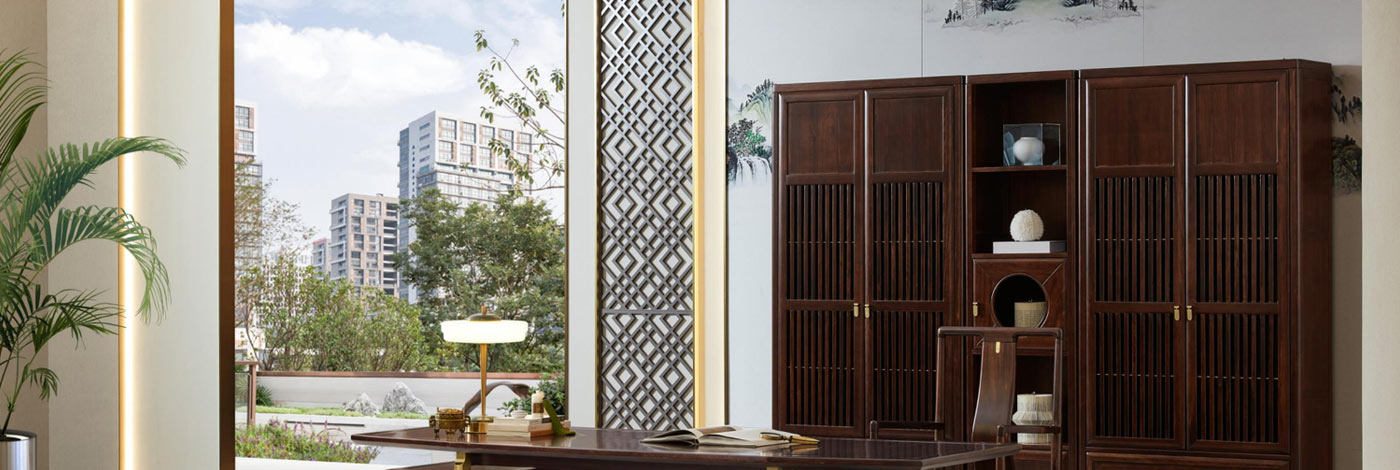
CUSTOMER NEEDS ARE OUR RESPONSIBILITY

Materials & Craftsmanship

High-Quality Ebony & Black Walnut Furniture Production.

Materials & Craftsmanship

High-Quality Ebony & Black Walnut Furniture Production.

Our materials and processes

Teak: The Golden Timber of Timeless Elegance

The King of Timbers

Teak (Tectona grandis) stands as one of the world’s most treasured hardwoods, earning its reputation as the “King of Timbers” through centuries of use in shipbuilding, fine furniture, and architectural masterpieces. Native to Southeast Asia—particularly India, Myanmar, Thailand, and Indonesia—this remarkable timber is now cultivated across tropical regions worldwide.

Wood Characteristics

Teak is celebrated for its stunning natural beauty and exceptional physical properties. The heartwood begins as a dark golden yellow, maturing to a rich, dark brown with exposure to light, while the sapwood remains pale yellowish-white.

With a specific gravity of 0.55 to 0.70 and an air-dry density of approximately 40 pounds per cubic foot, teak strikes an ideal balance between strength and workability. The grain is typically straight, occasionally wavy, with a coarse, uneven texture.

The Secret to Durability: Teak’s extraordinary resilience comes from its high natural oil and rubber content. These compounds create an impermeable barrier against moisture, fungal decay, and insect attack, making teak practically impervious to rot and termites.

Origin and Sources

Teak is predominantly distributed in tropical and sub-tropical countries across South Asia (India, Myanmar, Thailand), Southeast Asia (Indonesia, Malaysia, Laos), and parts of Africa.

The finest quality teak is often associated with mature plantation-grown timber from Indonesia’s Java region. While natural teak forests are increasingly protected, well-managed plantations ensure a sustainable supply of high-quality timber.

Grading System

Teak logs are classified into four primary grades based on timber recovery and visual quality:

  • Grade I: Export quality, girth above 150 cm, defect-free, uniform grain

  • Grade II: High-quality, minimal defects, excellent sawn timber yield

  • Grade III: Moderate quality, some visual defects, suitable for general furniture

  • Grade IV: Lower quality, knots or minor imperfections, secondary applications

Wood Characteristics

Professional Drying Process

01. Pre-treatment

After the logs are cut into boards, end sealing treatment is performed to prevent end cracking.

02. Kiln Drying Treatment

Using vacuum drying technology, the moisture content is reduced to 10-12% within 15-20 days.

03. Humidity Conditioning Treatment

Balancing in a constant temperature and humidity environment for 7-10 days to release internal stress in the wood.

04. Processing Adaptation

Adjusting the moisture content to the optimal state according to the climate characteristics of the region of use.

Daily Maintenance Suggestions

Maintenance Suggestion A

Moderate exposure to natural light can make the wood grain and color more lustrous, but avoid prolonged exposure to direct sunlight.

Maintenance Suggestion B

Maintain an ambient humidity of 35-65%. If it is too dry, place hydroponic plants to regulate humidity.

Maintenance Suggestion C

Wipe with a slightly damp, soft cloth. Use walnut oil or a special wood wax for maintenance 1-2 times per year.

Maintenance Suggestion D

Avoid scratching the surface with sharp objects. When placing heavy objects, it is recommended to use a non-slip mat.

High-quality black walnut wood

Wood Characteristics

Black walnut (Juglans nigra) has an air-dry density of 0.64-0.68 g/cm³. It is hard and resilient, with a wavy or curly grain. The color ranges from light brown to dark chocolate, featuring natural patterns with purple and gray tones. It has excellent workability, allowing for fine carving and bending, making it an ideal material for high-end furniture.

Origin and Place of Origin

Primarily sourced from the eastern United States (Pennsylvania, Ohio, Indiana) and Ontario, Canada, with American walnut being of the highest quality. Plantation forests are mainly distributed in Europe and China, but the grain and color are slightly inferior to those from natural North American forests.

Grading

FAS Grade (Premium): Defect-free surface, beautiful grain, primarily used for furniture panels, yield approximately 15%.
No.1 Common: Allows for a small number of natural knots, suitable for furniture frames and side panels.
No.2 Common: Varying grain patterns, high cost-effectiveness, used for concealed areas.

Price Stability

As a mainstream and precious hardwood in North America, black walnut’s price is relatively stable, influenced by market supply and demand and international trade:

From 2010 to 2025, the average annual price increase for FAS grade black walnut is approximately 3-5%, with a current market price of approximately 12,000-18,000 RMB/cubic meter.

Price fluctuation coefficient is approximately 8-10%, mainly affected by US log export policies and shipping costs.

Finished furniture prices are relatively stable, with good value retention, making it a mainstream choice for mid-to-high-end solid wood furniture.

Wood Drying and Maintenance Process

Materials and Craftsmanship

Professional Drying Process

01. Pre-treatment

After the logs are cut into boards, end sealing treatment is performed to prevent end cracking.

02. Kiln Drying Treatment

Using vacuum drying technology, the moisture content is reduced to 10-12% within 15-20 days.

03. Humidity Conditioning Treatment

Balancing in a constant temperature and humidity environment for 7-10 days to release internal stress in the wood.

04. Processing Adaptation

Adjusting the moisture content to the optimal state according to the climate characteristics of the region of use.

Daily Maintenance Suggestions

Maintenance Suggestion A

Moderate exposure to natural light can make the wood grain and color more lustrous, but avoid prolonged exposure to direct sunlight.

Maintenance Suggestion B

Maintain an ambient humidity of 35-65%. If it is too dry, place hydroponic plants to regulate humidity.

Maintenance Suggestion C

Wipe with a slightly damp, soft cloth. Use walnut oil or a special wood wax for maintenance 1-2 times per year.

Maintenance Suggestion D

Avoid scratching the surface with sharp objects. When placing heavy objects, it is recommended to use a non-slip mat.

Ebony, the King of Woods

Wood Characteristics

Ebony, also known as striped ebony, is a hard and dense wood with an air-dry density of 1.0-1.3 g/cm³, causing it to sink in water. It has a fine, lustrous grain, displaying alternating light and dark black stripes, giving it a sophisticated and luxurious appearance. It is highly resistant to wear, corrosion, and insects, and its stable nature makes it resistant to warping, making it a prized material for high-end furniture.

Origin and Place of Origin

It is mainly distributed in Southeast Asia (Indonesia, Malaysia, Thailand), East Africa (Mozambique, Tanzania) and Oceania. Among them, the ebony from Sulawesi Island in Indonesia is of the best quality. Due to its slow growth (it takes a hundred years to mature) and scarcity, it has been listed as a protected species under the CITES Convention.

Grading

Grade 1 Material: No knots or cracks, uniform texture, pure black color with fine gold veins, yield less than 15%.
Grade 2 Material: Minor natural knots, generally continuous texture, slightly lighter color.
Grade 3 Material: Obvious texture and color variations, minor repairs allowed, mainly used for secondary parts.

Price Stability

Due to its scarcity and protection policies, ebony wood prices have remained high and continue to rise: from 2010 to 2025, the average annual increase in the price of high-quality ebony raw materials is approximately 8-12%, with the price of first-grade material exceeding 100,000 yuan per cubic meter. While international trade policies and import quota restrictions cause price fluctuations of 15-20%, the overall trend remains relatively stable. Finished ebony furniture retains its value well, with high-quality ebony furniture appreciating by approximately 5-8% annually, making it a valuable collectible and investment.

Wood Drying and Maintenance Process

Professional Drying Process

01. air dry

After being cut, the logs are naturally dried in a ventilated shed for 6-12 months, reducing the moisture content to 25-30%.

02. Constant temperature drying

The product is placed in a professional drying kiln and dried for 20-30 days using a stepped temperature control method (30℃→60℃).

03. Balancing

Cool the wood to room temperature and balance the internal and external moisture content to 8-12% (compliant with national standards).

04. Secondary health preservation

Before finishing, place the finished product in a temperature- and humidity-controlled warehouse for 15-30 days to ensure the wood's properties stabilize.

bespoke furniture

Daily Maintenance Suggestions

Maintenance Suggestion A

Avoid direct sunlight to prevent the wood from cracking and fading in color.

Maintenance Suggestion B

Maintain an ambient humidity of 40-60%; a humidifier can be used during dry seasons.

Maintenance Suggestion C

Wipe regularly with a soft, pure cotton cloth and apply natural wood wax oil quarterly for maintenance.

Maintenance Suggestion D

Keep away from air conditioner vents and heating equipment to avoid excessive temperature differences.

Traditional process

01.Wood Treatment

Premium ebony, steamed-dried-cured, 9%-12% moisture content, crack & warp resistant.

02.Woodworking

Mortise and tenon joinery + CNC milling, secondary curing to relieve stress, and fine sanding create a stable raw material.

03.Substrate Treatment

Sealing primer hardens, sanding removes burrs, isolates moisture, and builds a solid, smooth base for the finish.

04.Color Finishing

Hand-rubbed coloring for wood grain; primer coats + fine sanding boost adhesion & fullness.

05. Finished Finish

Imported water-based eco-paint, 5-base+3-top thin coats, preserves wood grain, eco & odorless.

06. Finished Product

Premium auxiliaries + full-process QC, delivering sturdy, beautiful New Chinese solid wood furniture.

Case Studies

custom furniture
Custom Solid Wood Furniture Manufacturers

Full process quality control

Establish full cycle quality control standards from professional level environmentally friendly paint application to finished product stability testing. Compliant with national standards, making every piece of furniture both aesthetically pleasing and reassuring, suitable for modern living needs.

The new Chinese style sofa is not stepping on thunder! Solid white wax wood, simple relief, comfortable cushion for waist protection. The arrival is odorless, the installation is professional, and the cost-effectiveness is extremely high.

Elnino Nano 3 March 2025, 10:10 AM

The whole house's new Chinese style customization is amazing! Walnut wood has a good texture, is environmentally friendly and odorless, and the size is suitable for home decoration. Families with children can rest assured.

Rendy Ahmad 6 March 2025, 12:01 PM

The new Chinese dining table and chairs are worth it! All solid wood tenon and mortise structure, easy to take care of the rock plate table top, customer service awesome, and the installation master are considerate.

Andyno 10 March 2025, 11:00 AM

Self built house with stunning new Chinese style furniture! Wujinmu is finely crafted and customized to fit special layouts. It has been used for six months without deformation and is highly recommended.

Aldrey Bharan 11 March 2025, 11:11 AM
官网询盘

REQUEST PRODUCT INFO & QUOTE

官网询盘