
Table of Contents
Introduction
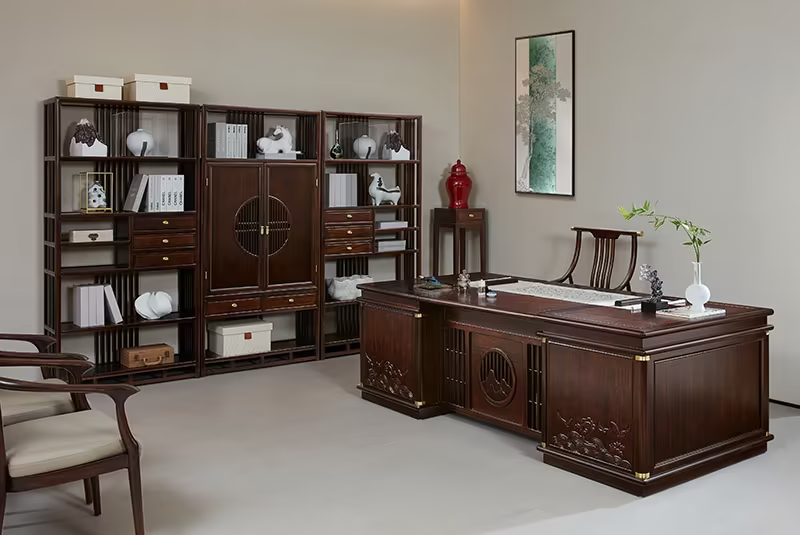
When planning a residential or commercial space, one of the most important decisions you will face is whether to choose custom furniture or ready-made furniture.
At first glance, ready-made furniture seems faster and more affordable, while custom furniture appears more tailored and premium. However, the real decision goes far beyond price or convenience.
In professional interior design and furniture planning, this choice directly impacts spatial efficiency, visual harmony, functionality, and long-term durability.
This guide breaks down both options in detail so you can make a well-informed decision based on real project needs rather than assumptions.
Understanding Custom Furniture
Custom furniture refers to pieces designed and manufactured specifically for a particular space, function, or requirement.
It allows full control over:
- Dimensions
- Materials
- Style direction
- Functional features
- Structural design
In professional projects, custom wood furniture is often used when standard sizing cannot meet spatial or functional requirements.
Understanding Ready-Made Furniture
Ready-made furniture is mass-produced in standard sizes and designs, available for immediate purchase and use.
Key characteristics include:
- Fixed dimensions
- Predefined styles
- Faster availability
- Lower initial cost
It is widely used in general residential setups where flexibility is not a priority.
Key Differences Between Custom Furniture and Ready-Made Furniture
To understand which is better for your project, it is important to compare them across practical factors.
Comparison Table: Custom Furniture vs Ready-Made Furniture
| Factor | Custom Furniture | Ready-Made Furniture |
|---|---|---|
| Fit for space | Perfectly tailored | Fixed sizes only |
| Design flexibility | Fully customizable | Limited options |
| Material selection | Wide control over materials | Pre-selected materials |
| Durability | Often higher with premium build | Varies by product line |
| Cost | Higher initial investment | More affordable upfront |
| Delivery time | Longer production cycle | Immediate availability |
| Long-term value | High for complex projects | Moderate |
| Project suitability | Residential, commercial, bespoke interiors | Quick setups, standard spaces |
Advantages of Custom Furniture
1. Perfect Space Utilization
One of the strongest advantages of custom furniture is spatial efficiency.
Instead of adjusting your space to fit furniture, custom wood furniture is designed to fit your space precisely.
This is especially important in:
- Irregular room layouts
- Small or narrow spaces
- High-end interior projects
2. Design Consistency
Custom furniture allows you to maintain a unified design language across the entire space.
This helps avoid:
- Style mismatches
- Color inconsistencies
- Proportion imbalance
3. Better Functional Planning
Custom furniture can be designed around how you actually use the space.
Examples:
- Integrated storage systems
- Multi-functional furniture pieces
- Project-specific layouts
4. Higher Long-Term Value
According to general furniture industry design studies referenced in interior planning literature, well-constructed custom furniture often provides longer lifecycle performance due to optimized material selection and structural design.
Advantages of Ready-Made Furniture
1. Faster Availability
Ready-made furniture is immediately available, making it suitable for urgent needs.
2. Lower Initial Cost
Because it is mass-produced, manufacturing costs are distributed across large volumes, reducing price per unit.
3. Easy Replacement
If a piece is damaged or needs replacement, identical units are often readily available.
4. Simple Decision Process
There is no need for design planning or technical customization, making it easier for quick setups.
When Custom Furniture Is the Better Choice
Custom furniture is ideal when:
- You need precise space optimization
- You want a unified interior design style
- You are working on a commercial or project-based interior
- You require specific materials or craftsmanship
- Long-term durability is a priority
In professional interior projects, custom wood furniture is often the default choice due to its flexibility and precision.
When Ready-Made Furniture Is Enough
Ready-made furniture works well when:
- The space is standard in size and layout
- Budget is the primary concern
- Quick setup is required
- Design customization is not important
It is a practical solution for short-term or flexible living arrangements.
Real-World Insight: Why Many Projects Combine Both
In many professional interior projects, the best solution is not choosing one over the other but combining both.
Typical approach:
- Custom furniture for key functional areas (storage, built-ins, large structures)
- Ready-made furniture for flexible or secondary elements
This hybrid approach balances cost efficiency and design quality.
Common Mistakes When Choosing Between the Two

1. Choosing Based Only on Price
Problem:
Low cost does not always mean long-term value.
2. Ignoring Spatial Constraints
Problem:
Ready-made furniture may not fit irregular layouts.
3. Over-Customizing Small Projects
Problem:
Unnecessary customization increases cost without added benefit.
4. Lack of Planning
Problem:
Decisions made without layout planning often lead to inefficiency.
Professional Decision Framework
Interior designers typically evaluate furniture strategy using the following steps:
- Analyze room dimensions and layout complexity
- Define functional requirements
- Identify design consistency goals
- Evaluate budget and timeline constraints
- Decide between custom, ready-made, or hybrid approach
- Optimize final layout for flow and usability
This structured method ensures both practicality and design quality.
Conclusion
There is no universal winner in the comparison between custom furniture and ready-made furniture. Each has clear strengths depending on how it is used.
If your priority is precision, long-term value, and design integration, custom furniture is usually the stronger option. If speed, simplicity, and budget efficiency matter more, ready-made furniture can be sufficient.
In many real-world projects, the most effective solution is a balanced combination of both, aligned with spatial needs and functional goals.
FAQ
Is custom furniture always better than ready-made?
Not always. It depends on project requirements, budget, and space complexity.
Why is custom wood furniture more expensive?
Because it involves tailored design, specialized materials, and individual production.
Can I mix custom and ready-made furniture?
Yes, many professional designs use a hybrid approach.
Does custom wood furniture last longer?
Often yes, due to better material selection and structural planning.
Is ready-made furniture good for small spaces?
It can work but may not fully optimize space usage.
Need Help Choosing Between Custom Furniture and Ready-Made Solutions?
If you’re unsure which option is best for your project, our team can help you evaluate your space and provide tailored recommendations based on functionality, design, and budget. Contact us today for a professional consultation and create a furniture solution that perfectly fits your project needs.