
Table of Contents
Introduction
When designing a living room, many people focus on choosing the right wooden sofa but overlook one of the most important spatial decisions: which direction it should face.
Sofa orientation is not just about aesthetics. It directly affects how people interact in the space, how movement flows through the room, and how comfortable the environment feels in daily use.
In interior design practice, sofa direction is considered a core element of spatial planning because it defines the primary visual axis and determines how the entire room is organized.
A poorly oriented wooden sofa can make even a well-furnished room feel unbalanced, disconnected, or difficult to use.
This guide explores professional principles used in spatial design to determine the best direction for a wooden sofa based on comfort, flow, and functional efficiency.
The Core Principle: A Sofa Should Always Face a Functional Anchor
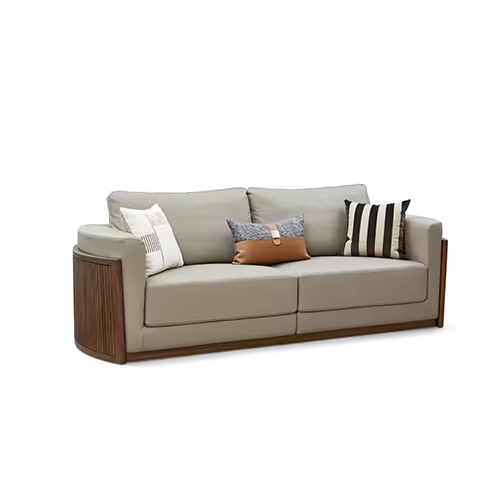
The most important rule in sofa placement is:
👉 A wooden sofa should always face a clear focal or functional point.
This focal point can be:
- A TV or media wall
- A central coffee table arrangement
- A fireplace or architectural feature
- A scenic window or natural view
- A conversation-focused seating cluster
Without a focal anchor, the room feels directionless and visually unstable.
Best Sofa Facing Directions Based on Room Function
Different spaces require different orientation strategies. There is no universal “one-direction-fits-all” rule, but there are proven design patterns.
1. Facing a Media Wall (Most Common Layout)
This is the most widely used configuration in modern interiors.
Why it works:
- Creates a clear entertainment zone
- Supports daily usage habits
- Establishes strong visual focus
Ideal for:
- Family living spaces
- Daily relaxation environments
2. Facing a Central Coffee Table Cluster
In this layout, the wooden sofa faces inward toward a seating group.
Why it works:
- Encourages social interaction
- Creates balanced conversation flow
- Improves spatial symmetry
Ideal for:
- Social living rooms
- Open-plan interiors
3. Facing a Natural View or Window
This orientation prioritizes external visual connection.
Why it works:
- Enhances psychological comfort
- Brings natural light into seating area
- Reduces visual fatigue
Based on environmental psychology studies referenced in interior design literature, natural-facing seating arrangements can improve perceived relaxation levels due to increased visual exposure to daylight and outdoor elements.
4. Facing a Floating Spatial Center
This is an advanced interior design strategy.
Structure:
- Wooden sofa faces inward, not toward walls
- Seating arranged around a central zone
- Coffee table acts as anchor point
Why it works:
- Creates architectural depth
- Enhances luxury perception
- Breaks traditional wall-bound layouts
Ideal for:
- Modern open spaces
- High-end interior projects
How Wooden Sofa Orientation Affects Comfort and Flow
Sofa direction influences three key aspects of interior performance:
1. Movement Flow (Circulation Efficiency)
If a sofa blocks natural walking paths or faces awkward directions, movement becomes restricted.
Professional guideline:
- Maintain clear circulation zones behind or beside sofa
- Avoid placing sofa directly in main traffic lines
Good orientation improves how people naturally move through space.
2. Visual Balance (Spatial Stability)
A wooden sofa is often a dominant visual element due to its size and material presence.
If it faces an empty wall or undefined space:
- The room feels incomplete
- Visual energy becomes unbalanced
If it faces a structured focal point:
- The room feels intentional and complete
3. Social Interaction Flow
Sofa orientation directly affects how people communicate.
- Facing inward → encourages conversation
- Facing outward → encourages passive viewing
- Side-facing → reduces engagement efficiency
Interior designers often prioritize interaction geometry when planning seating direction.
Wooden Sofa Orientation Comparison Table
| Sofa Facing Direction | Best Use Case | Comfort Level | Flow Efficiency | Design Impact |
|---|---|---|---|---|
| Media Wall | Daily living rooms | High | High | Functional |
| Coffee Table Center | Social spaces | High | Medium | Balanced |
| Window / View | Relaxation spaces | Very high | Medium | Natural |
| Floating Center | Luxury interiors | High | High | Premium |
Real-World Case Study: Improving a Poor Sofa Orientation
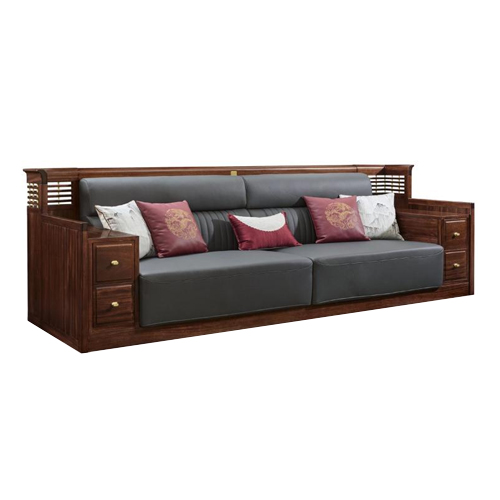
Scenario:
A wooden sofa was initially placed facing a blank wall with no functional purpose.
Problems Identified:
- No clear focal point
- Reduced visual engagement
- Weak spatial structure
- Low comfort perception
Adjustments Made:
- Sofa rotated toward central seating zone
- Coffee table repositioned as anchor
- Lighting adjusted to define focal area
- Walking path cleared for circulation
Results:
- Improved visual balance immediately
- Increased usability of seating area
- Stronger sense of spatial purpose
- More natural interaction flow
This demonstrates that sofa orientation alone can significantly change the perception of an entire room.
Common Mistakes in Wooden Sofa Placement
1. Facing Empty Walls
Problem:
- Creates visual emptiness
- Reduces spatial meaning
2. Blocking Natural Movement Paths
Problem:
- Interrupts circulation flow
- Makes room feel cramped
3. Ignoring Focal Point Logic
Problem:
- No clear visual direction
- Weak interior structure
4. Overlooking Scale and Proportion
Problem:
- Large sofa overwhelms space
- Small sofa feels disconnected
Professional Sofa Orientation Framework
Interior designers typically follow a structured process:
- Identify room function (social, relaxation, mixed use)
- Determine primary focal point
- Map circulation routes
- Position wooden sofa accordingly
- Adjust supporting furniture alignment
- Validate visual balance and usability
This method ensures both comfort and efficiency are achieved simultaneously.
How Custom Wooden Sofas Improve Layout Flexibility
Standard sofas often limit orientation options due to fixed dimensions.
Custom wooden sofas provide:
- Adjustable sizing for precise room fit
- Flexible orientation planning
- Better integration with spatial zoning
- Improved long-term usability
In high-end interior projects, customization is often essential for achieving optimal layout performance.
Conclusion
The direction a wooden sofa faces is not a minor detail—it is a foundational design decision that shapes how a space functions and feels.
By aligning sofa orientation with focal points, optimizing circulation flow, and maintaining visual balance, you can transform an ordinary room into a structured, comfortable, and highly usable environment.
When combined with well-designed wooden sofa systems, proper orientation becomes a powerful tool for improving both aesthetics and everyday living quality.
FAQ
What is the best direction for a wooden sofa to face?
It should face a functional focal point such as a media wall, seating center, or natural view.
Can a sofa face a window?
Yes, this is often preferred for relaxation spaces due to natural light and visual openness.
Should a sofa always face the TV?
Not always. It depends on whether entertainment is the primary function of the space.
Is it bad if a sofa faces a wall?
Yes, unless the wall is designed as a focal feature such as a media or art wall.
Does sofa direction affect room comfort?
Yes, it significantly influences movement flow, visual balance, and social interaction.
Need Help Designing the Perfect Wooden Sofa Layout?
If you’re unsure how to position your wooden sofa for the best comfort, flow, and visual balance, our team can help you create a tailored solution for your space and project requirements. Contact us today for a professional consultation and design a living space that feels balanced, functional, and built for long-term use.